Crabby the Crabapple
There are now six quarts of crabapple juice sitting on my kitchen table. They’ve been there for two days or so, waiting for the shelves in the porch to be cleared off enough to stack ’em away. Thing is, there were seven. The girls finally got around to drinking one.
Four gallons of crabapples (we used an empty peach case from the store to haul them home in) boiled up, strained through a piece of broadcloth and cooled, turned into two and a half gallons of usable juice. I also still have about six cups of pulp in the fridge, waiting to be turned into apple butter (yeah, it’s been a week, but it’s sealed really tight, our fridge is almost a freezer, and I’ll check it first).
Our family has always done things different, I suppose, but then – my grandparents didn’t have running water in the house until I was a baby (or maybe it was my older cousin who was a baby…well, one of us was a baby). Gran did things the way her mom did, and so on. I think everyone kept Gramps away from the apples, but that’s another story entirely. 😉
So, for those that care, here’s how we do it:
Wash the crabapples, strip the leaves if there are any and cut the blossom ends off. The rest goes into a giant pot (I used my steamer insert and a friend’s marmalade pot), stems, cores and all, until it’s three-quarters full. Barely cover with water, and let it come to a boil. After about ten minutes, turn the element off, and let it cool, still cooking the apples, for another ten minutes.
Gently lift the steamer insert (or just carefully scoop out the apples) and set the apples aside for a few moments. Pour the apple-water through the straining material (jelly bag, broadcloth, what have you) and set aside. Now turn the apples over into the cloth, and let it hang over a pail or large bowl for at least an hour, preferably overnight. I only let it sit for two, but I don’t care if my juice is cloudy, so I squeezed the bag…
Squeezing allows some pulp to slip through small spaces in the material, and it will cause juice and jelly to be cloudy. Like I said, I don’t care if the juice is cloudy, and honestly it looks more homemade if it is.
Once you’ve gone through this process until the apples are all cooked and they’ve dripped until they’re dry, you’re ready to make juice, or jelly.
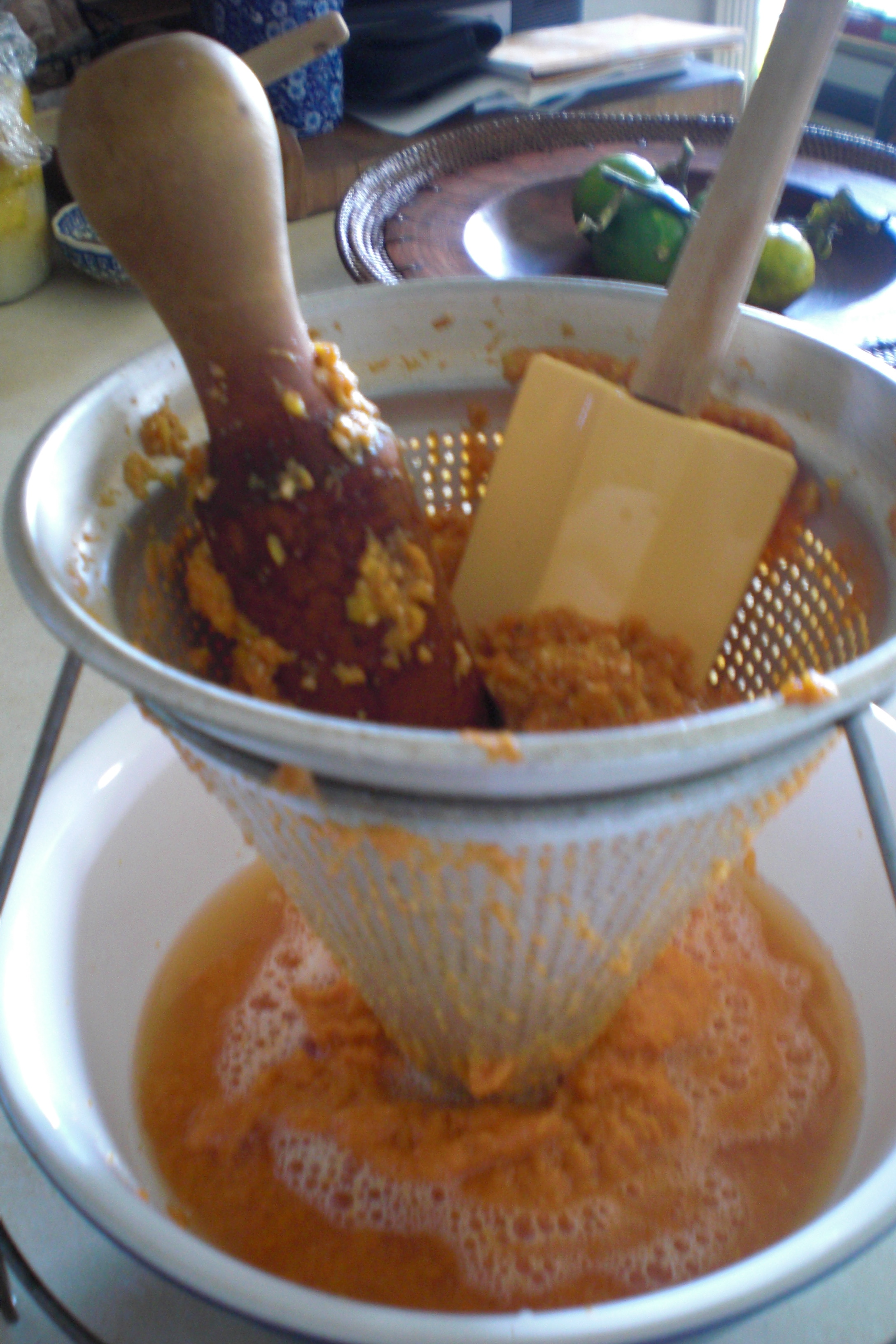
If you’re going to make jam, applesauce or apple butter, pulp the apples through a jam sieve. My gran’s looks almost exactly like the one in the picture linked there. Pulping takes a lot of patience, and that’s something I just don’t have, so I know I didn’t get as much as I probably could have. My gran was guilting me from the grave, I know it. If you’re not going to jam or sauce the apples, then they can hit the compost pile.
Back to the juice. If you’ve got a lot of juice, you may want to test it to see if it’ll be good for jelly. I don’t have to worry about that test, as the crabapples from our family’s trees are very high in pectin*. To do a test, boil up a cup of the juice, then take a teaspoon of the liquid onto a small plate, and mix it with a teaspoon of rubbing alcohol. Let it cool for a few minutes, and check for a clot of jelly. If there is one, rinse the sample from the plate (do not put it into the pot with the rest of the juice) and decide if you want juice or jelly.
For juice: (my amounts are in brackets)
1 quart of cooked apple water (10)
1/2 – 1 cup of sugar (4)
Bring to a full boil, then turn down to a rolling boil is maintained for ten minutes. Pour into hot, sterilized sealers leaving 1/2 inch head room.
Our family didn’t process the sealers afterward, just relying on the heat and sterilization to kill bugs… but we also didn’t wait around for the juice to go bad, either. I mean, I remember the homemade juice only lasting two months at most. However, it is now highly recommended that all foods that are preserved in such a way should also be processed in a hot-water bath (in a canner) for at least 15 minutes.
For what it’s worth, I didn’t process ours. One will be going to my mother’s for Thanksgiving dinner this weekend, one will be used at Samhain, and one will be put in the fridge for Yule. The rest… I imagine it’ll all be gone before the end of the month.
For jelly: (without commercial pectin)
1 part juice
1 part sugar
Set a small plate into the fridge to cool.
Bring juice and sugar to a rolling boil, maintained until the jelly stage is reached. The liquid in the pot should be thicker than when you started, and also have a foam forming on top. Pour a small amount onto the cooled plate, and see if it turns to jelly – if not, return the plate to the fridge and continue to boil the juice, stirring occasionally. Test it again, and hopefully you’ve now reached the jelly stage.
Remove from heat, skim the foam from the top (this is AWESOME on fresh buns with butter, btw) and pour into hot, sterilized sealers, leaving 1/3 inch head room. Again, processing is recommended (5 minutes in boiling water bath). Remove from the bath and cool on the counter or table, listening for that distinctive “ting” when the seal is made.
(I love that sound)
If you’re going to need to use pectin, I suggest following the package directions religiously. Companies like Certo KNOW what they’re doing. Frankly, I don’t. I never saw gran use it, she always had the apples from the tree (even for strawberry jam, she used our crabapples for the pectin…that’s how strong it is!)
For Crabapple Butter:
(this recipe is from www.homefamily.net, as no one can remember Gran’s recipe, and for that matter, she probably didn’t have one, per se.)
4 cups crabapple pulp
2 cups white sugar
1 tsp cinnamon
1/2 tsp allspice
1/2 tsp cloves
Mix pulp and sugar together in a large saucepan and stir until sugar is dissolved. Boil, stirring frequently until the mixture is the desired thickness.
Drop a teaspoon of the butter on a cold saucer and let it stand for a minute. If the butter is moulded and there is no liquid surrounding it, the butter is ready. Pour into hot sterilized pint (500 mL) jars and seal. Process in a boiling water bath for 20 minutes.
This one I probably will process… 😉 I have to say, I think I did a pretty good job. Granted, I’d have to have learned nothing from my grandmother (oh yeah, and mom too, I suppose) if I’d screwed it up.

 Loading ...